
If you’re buried deep in the dungeon of the American prison system, trying to understand how you got there, you can certainly analyze whatever the social system has stacked against you, against your class or race. You can examine what your neighborhood or school was like. You can look at what took place in your family system that predisposed you to something like drugs and violence. There could be a lot of elements in what conditioned how you acted and what set you up to take this fall. However true all that stuff may be, however much all these things could have shaped you, you are in the end stuck with your own actions. Where did your actions begin? They began in your mind.
You reacted to your emotions and logic, whatever got put there, and then you acted on it, and how you acted brought about this painful result. Maybe now you’re separated from your children or family. Maybe someone was injured or died from what you did. Every day, as the door locks unlock in the morning or lock again in the evening, you get reminded of what you did to get put there.
The truth is we’re all prisoners of our conditioning. It’s not purely the people who end up behind razor wire. We don’t understand our minds very well; we don’t see how conditioned we are; and we often don’t comprehend our poor choices and the bad outcomes they lead to. But we may still have to live with the suffering they produce in broken marriages, lost opportunities, ill health, estranged children, crippling debt, and many, many other conflicts that haunt us.
But, from the Buddhist point of view, while we are all products of our conditioning by culture, ethnicity, class, time and place, parentage, and so on, we have innately the potential to see through our delusions and awaken our own wisdom. Whether you’re sitting in a penthouse or on the edge of your bed in Ad-Seg, misery or happiness depends on your mind. That’s always there at the root of our experience. No doubt more people are happy in penthouses than in Seg, but you could just as easily be sitting in the lap of luxury and feel so unhappy you’ve got a gun barrel against your temple, contemplating whether you should pull the trigger.
While your internal psychology can torture and imprison you in your assumptions, habits, and addictions regardless of what the rest of your life looks like, when you get a felony conviction, imprisonment is no longer a metaphor. It’s literally what your life has come to. But either way, you’re challenged to deal with that internal psychology and all the things that shaped it. If there’s any good news here, it’s that you can learn to see what’s going on in your mind, what leads you into the darkness, and what starts you down the track that leads outside the prison gates.
You might want to be rescued. You might want the angels to come down singing out of the sky to lift you into some transcendental, heavenly penthouse. But that’s unlikely to teach you anything worth learning. People can teach us about how the mind works, give us methods for changing our ways, but it’s something that has to be done from the inside—from inside the prison of our minds. That’s literally the only way out.
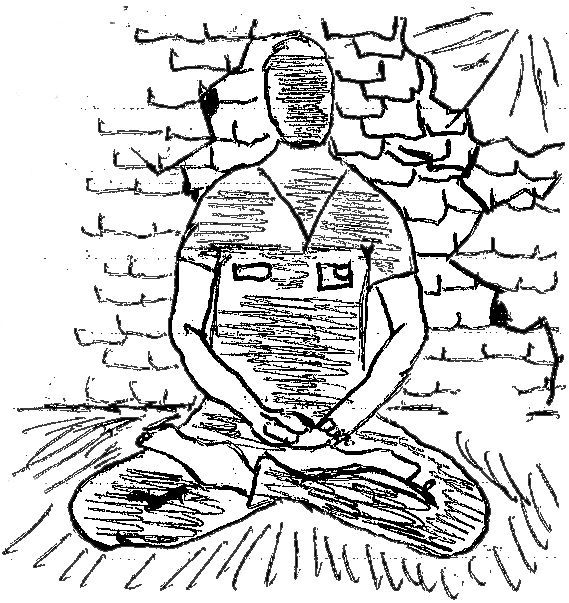
The tool the Buddha gave to his students was sitting meditation. Here you’re sitting up straight, you’re not going anywhere or doing anything. There’s no entertainment to keep you occupied, no TV or tablet or con games. It’s just you and who you are, but you’re given something to train yourself with, like mindfulness of breathing. Your breath goes on continuously and reliably. It’s not an interesting subject usually, but it steadies you. You’re going to need steadying as you start to witness just how crazy your thought process is.
When you’re forced to look at it, it’s darting from one thing to the next or getting caught on some hook, going around and around and around some stupid thing that happened 15 years ago. It wanders off in HD daydreams of sexual conquest or violent revenge. It maunders on about how unfair it all is. It yearns for some buffalo wings. It comes back to that thing that happened 15 years ago and goes around it again.
There’s no end to it. If you had a cellie who said all these things out loud without stopping, you’d probably be ready to kill him. But it’s your mind. That’s who you’re in the cell with.
The saving grace here becomes the breath, which may only lead you back to right where you are, but it does show you that you can learn to drop your captivation with your thoughts. That in fact is the key point, the true point of bondage to the mind. It’s not so much all the crazy, repetitious, chaotic thoughts; it’s clinging to those thoughts that’s the bondage. When you release them, come back into your body, into the here and now, that’s where you can contact something much more fundamental in yourself: your own goodness of being.
My Buddhist teacher, Chögyam Trungpa, called this basic goodness. It’s the goodness of being that exists in all of us, whether you’re a felon or out on the street. It comes before we get lost in what society calls “good” or “bad.” It’s a fundamental health and sanity that exists in us, before our culture talks us into what it thinks we should be, or before we launch into some idiotic scheme that ends in disaster. At this moment, when you’ve let go of the thinking, brought yourself back to the breath, into right now, you might start to get a glimmer of the mind settled into its own calm and clarity. Maybe there’s a noisy cell block, but for a moment you’re not caught up and reacting to that. There’s no need to act out. You can discern much more easily a good idea from a stupid one because for once you’re calm and not reactive.
It’s not a struggle to be who you are. In fact, you’re only just starting to learn who you are. You might find that there’s a lot to learn.

Really good, and truth for for all of us.
Thank you for what you are doing. My son just received his welcome packet from Ratna Peace Initiative so that he can start a Buddhist meditation group at the prison where he is located. I am excited about this new chapter in his life!